

Research & Spatial Understanding
Reviewed the station experience, visitor journey, and booth context to identify the moments that needed to feel clear in VR.
NCRTC, India
2022
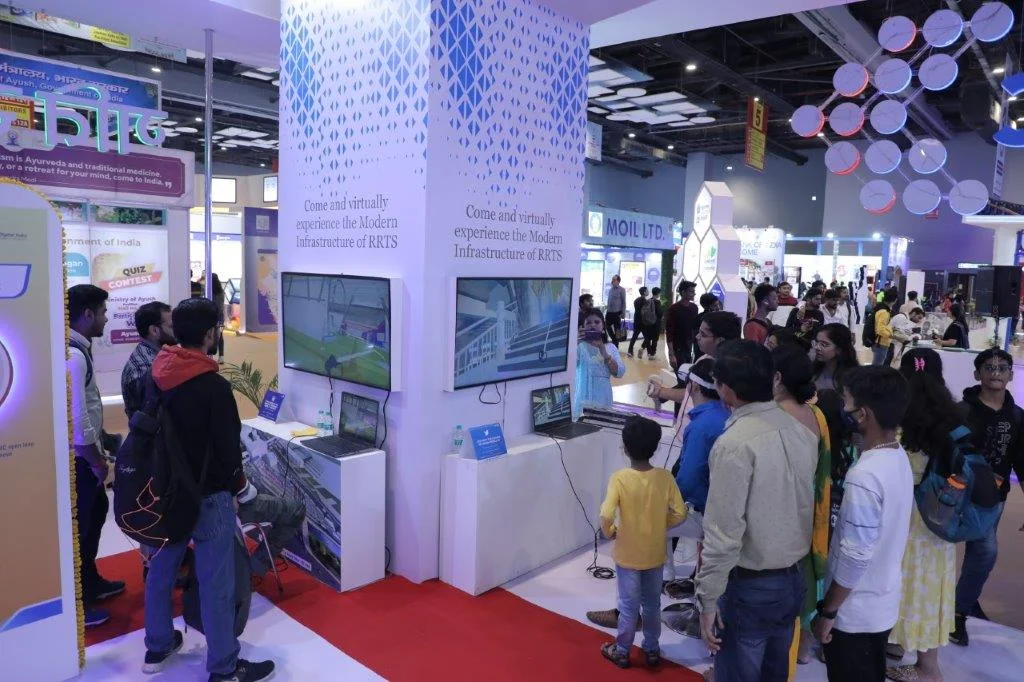
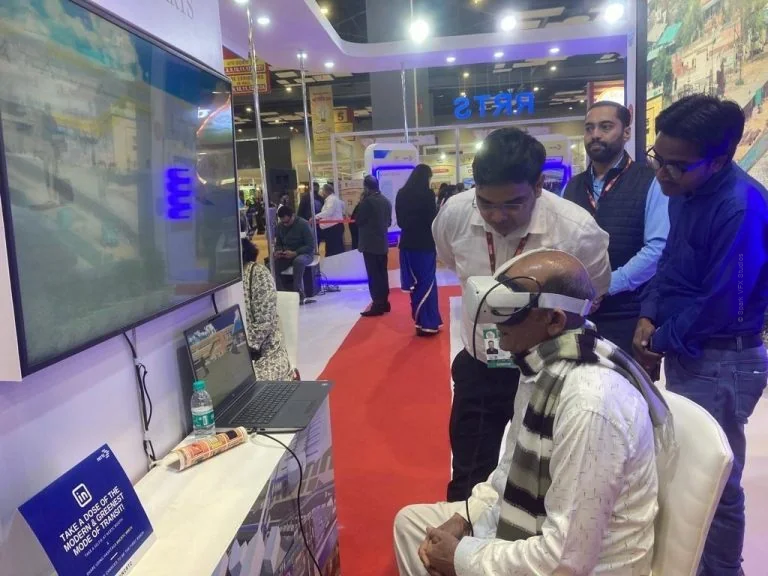
For NCRTC’s Namo Bharat exhibition kiosk, Spark Vfx Studios developed a layered immersive showcase that helped visitors understand the future RRTS station experience before the infrastructure was fully visible to the public.
The experience combined a VR station walkthrough, holographic exhibition content, and a branded photo-booth layer. Visitors could move through a virtual concourse, stairwell, platform, and train-arrival sequence, making the project easier to understand at human scale.
The work sits within Spark’s Projection Mapping and Immersive Experience Design practice and adds a strong public-sector proof point for Government And Tourism communication.
The project had to make complex transport infrastructure feel simple, comfortable, and exciting inside a busy trade-fair environment. Visitors were not trained VR users, so the experience needed to feel intuitive from the first moment.
The creative challenge was to translate station design, passenger flow, scale, signage, lighting, and transitions into a smooth walkthrough that could run reliably on headset hardware.
The kiosk also had multiple experience layers: VR, holographic content, and a photo-booth moment. Each had to feel connected to the same Namo Bharat story without overwhelming visitors or slowing down booth movement.
The objective was to help visitors, stakeholders, and decision-makers experience the future Namo Bharat station environment in a direct and memorable way.
Spark Vfx Studios built the experience around visitor clarity. The VR journey focused on recognisable station moments: entry, concourse movement, staircases, platform view, signage, and train arrival. This gave audiences a natural sense of direction and scale.
The holographic content added a futuristic booth layer, creating a high-attention moment inside the physical kiosk. The photo-booth interaction extended the experience beyond the headset by giving visitors a branded participation moment they could share.
The result was a compact but layered Interactive and Experiential Media Design project built for fast-moving exhibition conditions.
Reviewed the station experience, visitor journey, and booth context to identify the moments that needed to feel clear in VR.
Mapped the walkthrough from concourse entry to platform view so visitors could understand movement without feeling disoriented.
Created station environments, signage, lighting, crowd cues, and motion details to make the future transit space feel believable.
Prepared holographic and photo-booth content so the physical booth, VR experience, and brand presence felt connected.
Balanced visual quality and performance for smooth headset playback and reliable exhibition use.
The NCRTC booth became a stronger public engagement space by turning a future station into something visitors could enter, explore, and remember. Instead of only reading about RRTS features, audiences could experience the station environment at personal scale.
Public coverage from IITF 2022 described the VR zone as a visitor attraction, reinforcing the value of immersive media for infrastructure communication. The showcase helped NCRTC present commuter-centric planning, station design, and the promise of Namo Bharat in a more accessible format.
For public-sector teams, transit authorities, and exhibition planners looking to turn complex ideas into spatial experiences, contact Spark Vfx Studios to discuss immersive media for exhibitions, museums, and infrastructure showcases.
Spark Vfx Studios partnered with Folklogue Studios to produce Panchagni Vidya, a stereoscopic 7D mythological experience for an ashram theatre
Spark Vfx Studios contributed as a third-party visual content vendor for exhibit documentary films at the Netaji Subhas Chandra Bose

DISCUSS NEW PROJECT OR JUST TO SAY HELLO GET IN TOUCH WITH US
Cookie preferences
We use necessary cookies to run this website. With your permission, we may also use analytics cookies to understand visitor behavior and improve our content.