

Historical Script Interpretation
The historical narrative was broken into mapped moments that could move across the physical city model clearly.
Visitor Center Red Fort, New Delhi
2020
Historical maps can be difficult for visitors to read, especially when the story involves centuries of planning, movement, political change, and urban growth. Shahjahanabad needed to become spatial, immediate, and easy to understand.
Spark Vfx Studios supported the projection-mapped historical film as a third-party media production vendor in India. The installation used an approximately 14-foot-high curved canvas with a detailed extruded physical map, where raised streets, fort walls, mosques, routes, and architectural forms became the surface for animated history.
As part of Spark Vfx Studios work in Projection Mapping and Immersive Experience Design and the Projection Mapping and Fountain Shows portfolio, the film used mapped animation, bilingual text, subtle music, and two-projector blending to turn Shahjahanabad into a museum-scale spatial narrative.
The core challenge was registration accuracy. Animation had to align with extruded details measuring only 1 to 2 cm, including narrow streets, monument outlines, the Red Fort walls, Jama Masjid, water channels, gates, and routes.
The installation also required two projectors to blend into one continuous image across a large, slightly curved surface. Distortion correction, edge matching, and calibration had to preserve precise alignment even around miniature architectural forms.
The storytelling challenge was just as demanding. More than four centuries of urban history had to be communicated without voiceover, relying on animated light, color, bilingual text, historical sequencing, and music to guide visitors through the city story.
The objective was to transform a complex historical map into an accessible spatial experience that helped visitors understand how Shahjahanabad was conceived, organized, and transformed.
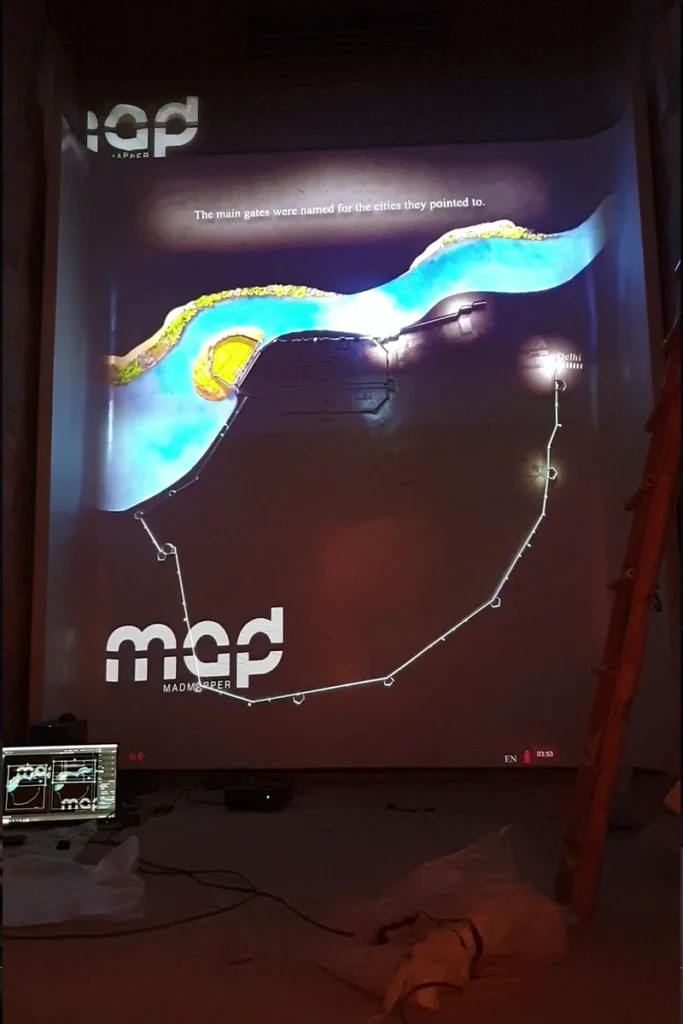
Spark Vfx Studios interpreted the historical script as a mapped journey across the relief model. Instead of treating the map as a static object, the film used light, animation, and movement to reveal relationships between the fort, river, streets, gates, and monuments.
The production included visual concept development, film production, animation, content preparation for the extruded physical map, projection mapping, two-projector blending, and precision calibration. Each projected layer had to meet a real physical feature on the map.
Key sequences moved from Salimgarh Fort and the Yamuna to Shah Jahan selecting the site of the capital, the walled city forming, gateways emerging, Jama Masjid appearing, Chandni Chowk coming to life, the Yamuna shifting course, and the historic city transforming toward present-day Old Delhi.
The historical narrative was broken into mapped moments that could move across the physical city model clearly.
Streets, gates, monuments, river movement, and routes were planned around their exact relief-model positions.
Mapped animation, bilingual text, route reveals, landmark highlights, and visual transitions were created for the film.
Two projectors were aligned, blended, and corrected so the image matched the curved extruded map surface.
Final media was synchronized with text and music, then refined for visitor clarity and permanent installation use.
The completed installation became part of the Red Fort Interpretation Centre visitor experience, presenting Shahjahanabad as a connected urban system instead of a conventional static map. The mapped film helped visitors understand how the city, fort, river, routes, markets, monuments, and water systems related to one another.
Independent coverage later highlighted the wider centre combination of projection mapping, scale models, and immersive technologies. The broader visitor-orientation centre also received international design recognition; this is best understood as contextual recognition for the overall centre, not a standalone award for this specific film.
For museums, heritage centres, interpretation spaces, and cultural destinations, teams can contact Spark Vfx Studios to create projection-mapped history films and spatial visitor experiences.
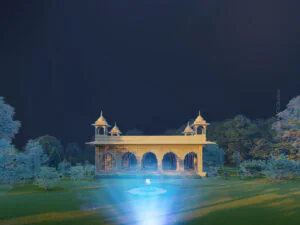
Spark Vfx Studios created an immersive projection mapping show at Red Fort, transforming heritage architecture into a cinematic visitor experience
Spark Vfx Studios produced the musical fountain show film for Medicinal Park, Noida, in collaboration with Folklogue Studios. As a
Spark VFX Studios produced all media content for Dashavatar, a musical fountain and water-laser show at Janeshwar Mishra Park in
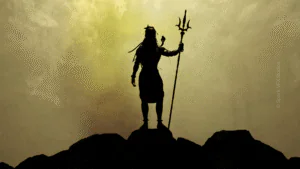
A large-scale 3D projection mapping case study where Spark Vfx Studios transformed Diu Fort into an immersive cultural storytelling experience.

DISCUSS NEW PROJECT OR JUST TO SAY HELLO GET IN TOUCH WITH US
Cookie preferences
We use necessary cookies to run this website. With your permission, we may also use analytics cookies to understand visitor behavior and improve our content.